
The nozzle may be one of the smallest components on a 3D printer, but it has a major influence on print quality, printing speed, material compatibility, and long-term reliability.
For everyday PLA and PETG printing, a standard 0.4 mm nozzle is often enough. But once you begin printing abrasive materials, pushing higher flow rates, producing larger functional parts, or chasing finer details, the stock nozzle can become one of the limiting factors in your printing system.
This guide explains how to choose a 3D printer nozzle based on three key factors:
Nozzle diameter, flow design, and nozzle material.
1. Why Change Your 3D Printer Nozzle?
A standard 0.4 mm nozzle is popular for a good reason: it provides a practical balance between speed, print quality, slicing flexibility, and reliability.
For general-purpose materials such as PLA and PETG, there may be no reason to replace it.
However, changing or upgrading the nozzle becomes useful when your printing requirements change.
Typical situations include printing abrasive filaments, increasing production speed, producing small detailed models, manufacturing larger structural parts, or using more demanding engineering materials.
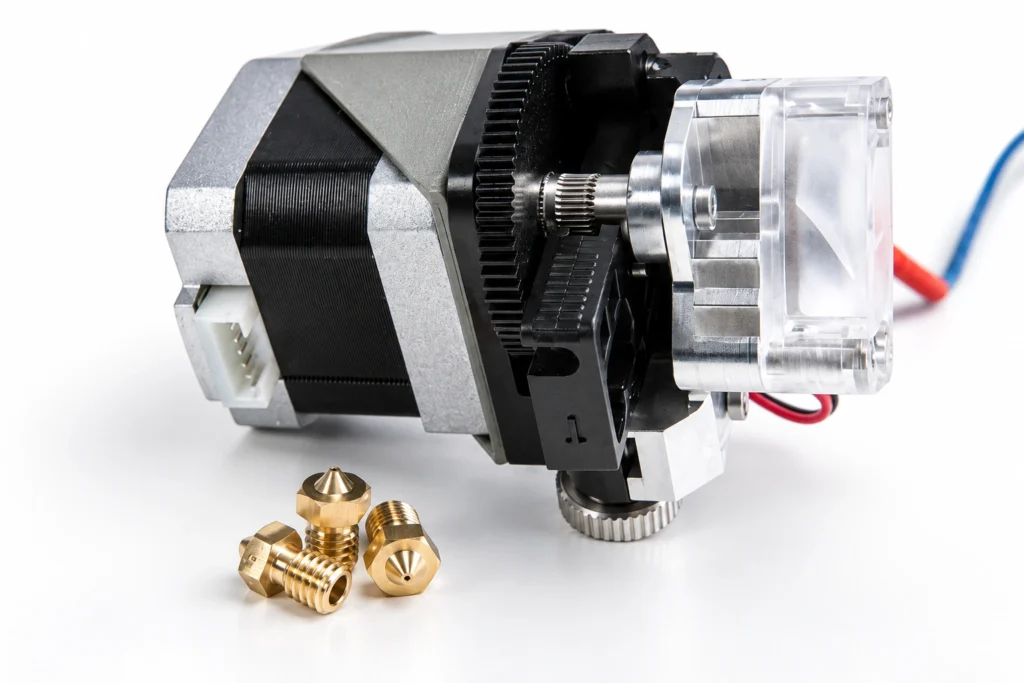
Before choosing a replacement nozzle, it is important to understand the difference between the nozzle, hotend, and print head.
What Is a Nozzle?
The nozzle is the final outlet through which molten filament leaves the hotend.
Its diameter directly affects extrusion width, achievable detail, and potential material flow.
What Is a Hotend?
The hotend is the melting system around the nozzle.
Depending on the printer design, it may include the nozzle, heater, temperature sensor, heat block, heat break, heatsink, and related components.
What Is a Print Head?
The print head is the larger moving assembly.
It may contain the hotend, extruder gears, cooling fans, sensors, and other mechanical or electrical components.
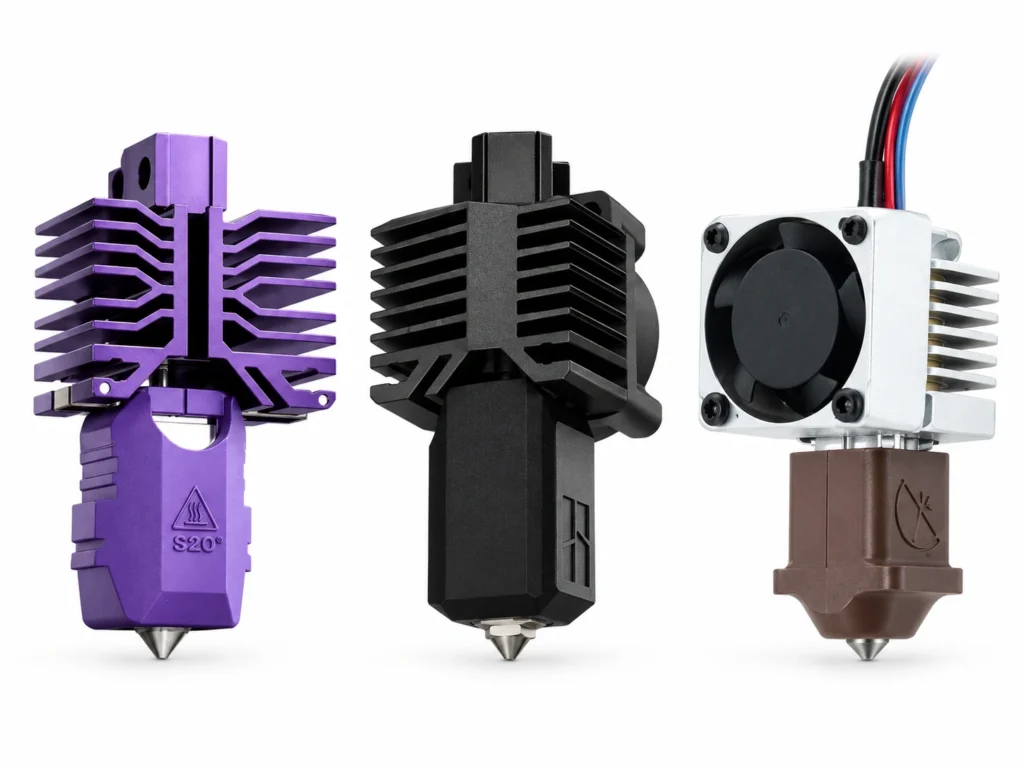
Understanding these differences is especially important on modern printers because many newer machines use integrated or proprietary hotend systems rather than traditional interchangeable threaded nozzles.
2. OEM Nozzles vs. Third-Party Nozzle Systems
Many older desktop 3D printers use relatively standardized threaded nozzle formats, which makes nozzle replacement straightforward.
As long as the thread, length, and geometry are correct, users can often choose from a wide range of compatible third-party nozzles.
Modern printers increasingly use dedicated or integrated hotend designs.
This can make maintenance easier, but it also means a nozzle that looks similar may still be incompatible.
Before purchasing a replacement nozzle or hotend, confirm:
- Printer model
- Hotend interface
- Thread or integrated assembly type
- Nozzle length
- Heater-block geometry
- Filament diameter
- Manufacturer temperature specifications
Third-party manufacturers also provide replacement hotends and compatible upgrade systems for selected printer platforms.
These products can expand the range of nozzle sizes, materials, or high-flow options available to users.
However, compatibility should always be checked against the exact printer model and the current manufacturer’s specification.
3. Nozzle Diameter: Speed vs. Detail
Nozzle diameter is one of the easiest nozzle characteristics to understand.
A smaller nozzle provides greater control over small features.
A larger nozzle can extrude a wider line and potentially deposit more material per second.
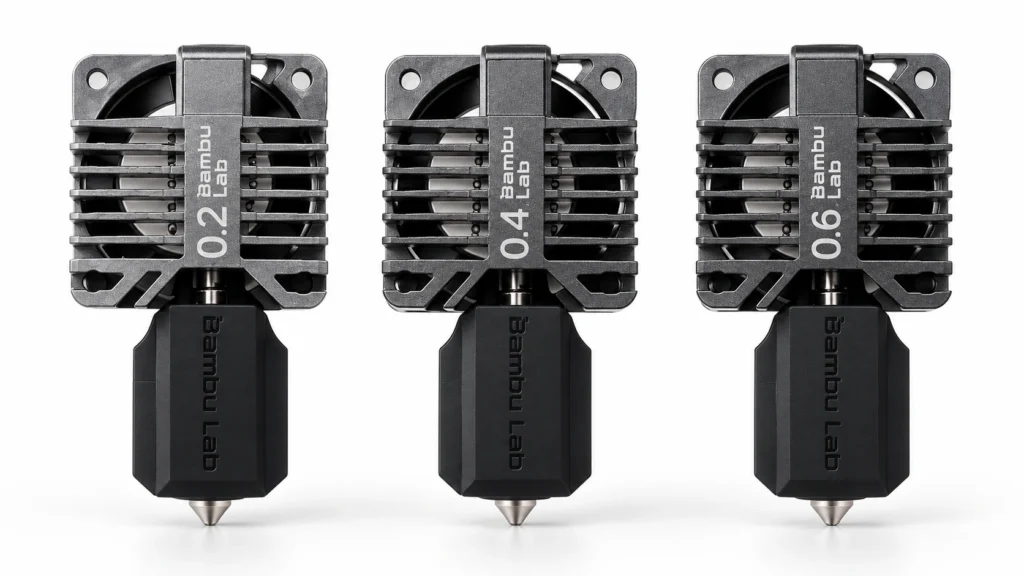
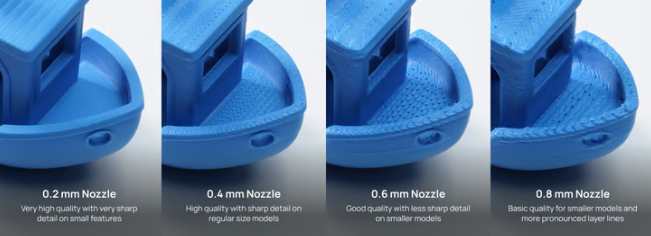
0.2 mm — Fine Details
A 0.2 mm nozzle is useful for applications such as miniatures, small lettering, decorative models, and detailed prototypes.
Because the extrusion width is smaller, it can reproduce smaller features more accurately.
The trade-off is printing speed.
Smaller nozzles normally require more toolpaths to fill the same area and can also be more sensitive to contamination or particles in the filament.
0.4 mm — General-Purpose Printing
For most desktop FDM printers, 0.4 mm remains the best all-around starting point.
It offers a good balance between:
- Print quality
- Speed
- Reliability
- Material compatibility
- Slicing flexibility
For normal PLA, PETG, ABS, ASA, and similar materials, a 0.4 mm nozzle can handle a very wide range of everyday printing tasks.
0.6 mm — Functional Parts and Higher Throughput
A 0.6 mm nozzle is often a good choice when production speed becomes more important than very fine detail.
Typical applications include functional parts, fixtures, brackets, structural components, and medium-to-large models.
A wider extrusion line can reduce the number of toolpaths required to build a part.
0.8 mm and Larger — Large Parts
Larger nozzles are generally used when productivity and material deposition are more important than fine surface detail.
They can be useful for large models, structural prototypes, large fixtures, and applications where print time is a major consideration.
However, increasing nozzle diameter does not automatically guarantee faster printing.
The hotend still needs enough melting capacity to supply the required material flow.
If the requested volumetric flow exceeds the hotend’s capability, under-extrusion can occur even with a larger nozzle.
A Practical Layer Height Rule
As a general starting point, maximum layer height should remain comfortably below the nozzle diameter.
The exact limit depends on nozzle geometry, printer design, filament, extrusion settings, and slicer configuration.
4. High-Flow Nozzles: More Speed Without Only Increasing Diameter
There is another way to increase printing speed besides using a larger nozzle:
Improve how efficiently the filament melts before it reaches the nozzle outlet.
This is the basic idea behind high-flow nozzle and hotend designs.
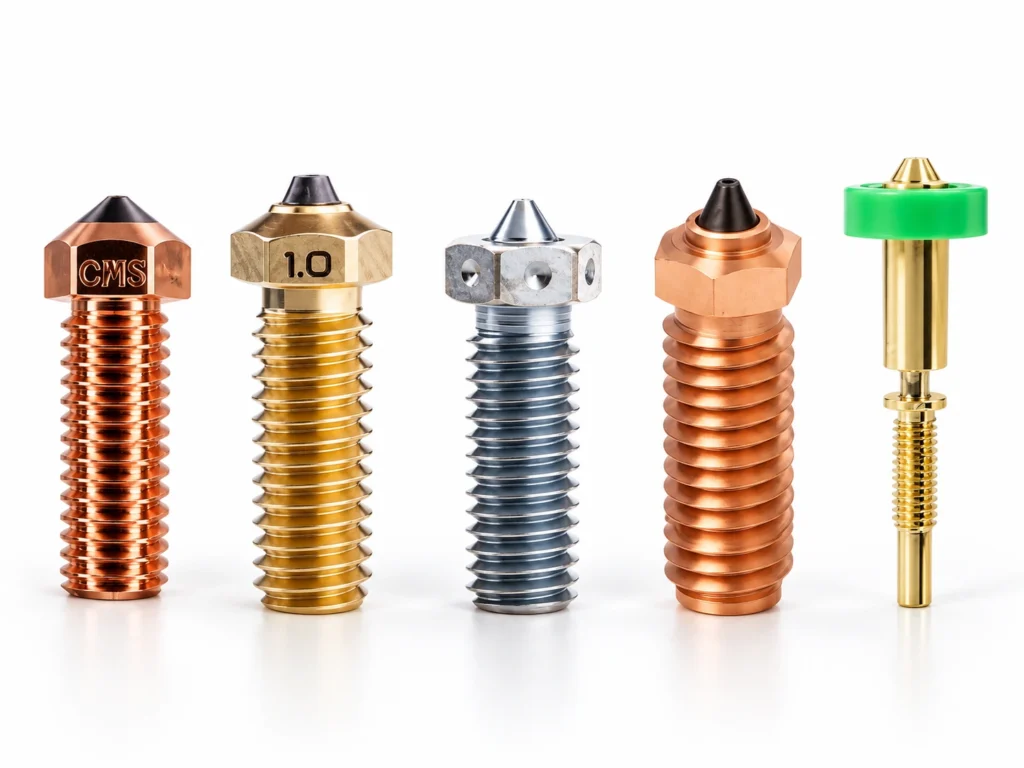
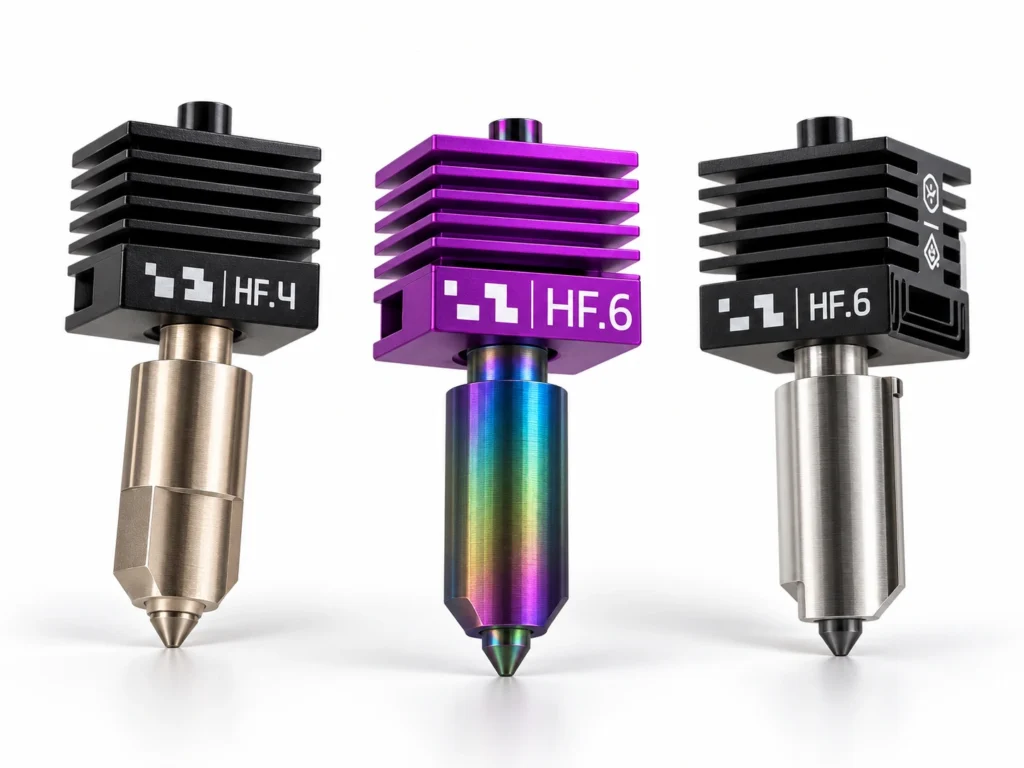
Longer Melt Zones
One common approach is to increase the length of the heated filament path.
A longer melt zone gives the filament more time and more heated surface area before it is extruded.
This can allow more material to be melted per second.
However, the actual flow capability of a hotend also depends on several other factors, including heater power, printing temperature, filament type, extruder force, nozzle diameter, and print speed.
Optimized Internal Flow Paths
Another approach is to modify the internal geometry of the nozzle.
Some high-flow designs divide the incoming filament into smaller streams inside the nozzle.
This increases contact between the filament and the heated nozzle surfaces, helping the material melt more efficiently before leaving the nozzle.
The result can be higher volumetric flow without requiring an extremely long hotend.
For users operating high-speed printers or print farms, high-flow hotends can be more useful than simply installing a larger nozzle.
5. Nozzle Material: Thermal Performance vs. Wear Resistance
Nozzle diameter is only part of the selection process.
The nozzle material is equally important because different materials provide different combinations of heat transfer and wear resistance.
Brass and copper-based nozzles are widely used because they provide good thermal performance.
They are suitable for many common materials, including PLA, PETG, ABS, ASA, and TPU.
For normal non-abrasive filament, a quality brass or copper-alloy nozzle is often the most practical choice.
Their main limitation is wear resistance.
Filaments containing hard particles can gradually wear the nozzle opening.
Stainless Steel Nozzles
Stainless steel nozzles are used for specific applications where the material properties of stainless steel are useful.
Compared with brass, stainless steel generally transfers heat less efficiently.
It should not automatically be considered the best option for abrasive filament simply because it is steel.
Always check the actual nozzle manufacturer’s specification.
Hardened Steel Nozzles
Hardened steel is a common choice for abrasive filaments.
Typical examples include:
- Carbon-fiber-filled filament
- Glass-fiber-filled filament
- Glow-in-the-dark filament
- Some metal-filled filaments
Its primary advantage is improved wear resistance.
The trade-off is different thermal behavior compared with brass or copper-based nozzles, so printing temperature or speed may sometimes need adjustment.
Tungsten Carbide and Other Wear-Resistant Materials
For users who regularly print abrasive filament, higher-end wear-resistant nozzle materials can provide longer service life.
These options usually cost more, but they may reduce downtime caused by frequent nozzle replacement.
Bi-Metal and Composite Nozzles
Some nozzles combine different materials in one design.
For example, a nozzle may use a thermally conductive body together with a harder, wear-resistant tip or insert.
The goal is to combine:
Good heat transfer + improved abrasion resistance.
This can be especially useful for professional users who need both consistent flow and long service life.
Important Temperature Note
Maximum printing temperature should always be taken from the specification of the specific nozzle and hotend system.
Do not assume that every nozzle made from the same material has the same temperature limit.
6. Which Nozzle Should You Choose?
Choosing a nozzle becomes much easier once you identify what is actually limiting your print.
| Printing Requirement | Recommended Starting Point |
|---|---|
| Everyday PLA / PETG printing | 0.4 mm brass or copper-alloy nozzle |
| Miniatures and fine details | 0.2–0.25 mm nozzle |
| Functional parts | 0.6 mm nozzle |
| Large parts / faster output | 0.6–0.8 mm nozzle |
| Carbon-fiber filament | Wear-resistant nozzle |
| Glass-fiber filament | Wear-resistant nozzle |
| Glow-in-the-dark filament | Wear-resistant nozzle |
| High-volume production | High-flow nozzle or hotend |
| High-temperature engineering material | Complete high-temperature-capable hotend system |
One important point:
A nozzle alone does not make a printer suitable for PEEK or other high-temperature engineering materials.
The heater, heat block, temperature sensor, heat break, extruder, and sometimes the enclosure must also be suitable for the required printing conditions.
7. Do You Need One Universal Nozzle?
For occasional home printing, a standard 0.4 mm nozzle may be enough.
For professional users, workshops, distributors, and print farms, keeping several nozzle types available is usually more practical.
A useful nozzle selection may include 0.2 or 0.25 mm for detail, 0.4 mm for general printing, 0.6 mm for functional parts, 0.8 mm for larger parts, and wear-resistant options for abrasive materials.
High-flow nozzles or hotends can also be useful when the main limitation is volumetric flow rather than nozzle diameter.
Instead of asking:
“Which nozzle is the best?”
A better question is:
“What is limiting my current print — detail, material flow, wear resistance, or temperature?”
Once that is clear, nozzle selection becomes much easier.
Frequently Asked Questions
What Is the Best Nozzle Size for General 3D Printing?
For most desktop FDM printers, a 0.4 mm nozzle is a good general-purpose choice because it provides a useful balance between detail, speed, and reliability.
Can a Brass Nozzle Print Carbon-Fiber Filament?
It may be physically possible, but carbon-fiber-filled filament is abrasive and can wear a standard brass nozzle relatively quickly.
A wear-resistant nozzle is normally more appropriate for frequent use.
Does a Larger Nozzle Always Print Faster?
No.
A larger nozzle can increase potential material deposition, but actual speed also depends on hotend melt capacity, heater performance, filament, extruder force, and slicer settings.
What Is a High-Flow Nozzle?
A high-flow nozzle or hotend is designed to melt more filament per unit of time.
This can be achieved through a longer melt zone, optimized internal geometry, or other methods that increase heat transfer to the filament.
Can I Print PEEK Just by Changing the Nozzle?
No.
PEEK and other high-temperature engineering materials require a complete printing system capable of handling the necessary temperatures and environmental conditions.
Final Takeaway
The nozzle may be small, but choosing the right one can significantly affect printing performance.
For everyday printing, a 0.4 mm general-purpose nozzle remains an excellent starting point.
For finer detail, use a smaller nozzle.
For larger functional parts and higher throughput, consider a larger nozzle.
For abrasive materials, prioritize wear resistance.
And when printing speed becomes the main priority, evaluate the entire hotend and melt system rather than simply increasing nozzle diameter.
Looking for 3D Printer Nozzles and Hotend Accessories?
BARO3D supplies 3D printer accessories and replacement parts for distributors, resellers, print farms, and professional users.
Whether you need standard replacement nozzles, different nozzle sizes, wear-resistant options, hotend components, or compatible 3D printer accessories, we can help you select products based on your printer platform and application.
Contact BARO3D info@baro3d.com for product lists, wholesale pricing, and compatibility support.
Third-party brand names and product names are used for identification and compatibility reference only. All trademarks belong to their respective owners.